

Ask a team to cut their serverless bill and they will reach for the same two dials every time: Lambda memory and Lambda duration. It is the wrong place to look. In most modern serverless applications, the Lambda functions are the cheapest thing on the invoice. The money is in the gaps between them.
Serverless is about coordination, not functions. The state machines, the API proxies, the message queues, the event buses: the connective tissue that shuttles a request from one function to the next is what you are actually paying for, and it is almost never the thing anyone profiles. Trim another 128 MB off a Lambda and you save pennies. Fix how your functions talk to each other and you move the bill.
Here is a practical, engineering-focused breakdown of the most notorious AWS serverless orchestration cost traps, along with the exact Terraform configurations and architectural patterns needed to eliminate them.
The State Transition Penalty (Step Functions Standard vs. Express)
AWS Step Functions is the gold standard for orchestrating distributed serverless workflows. However, deploying the wrong workflow type into a high-throughput pipeline can introduce severe cost penalties.
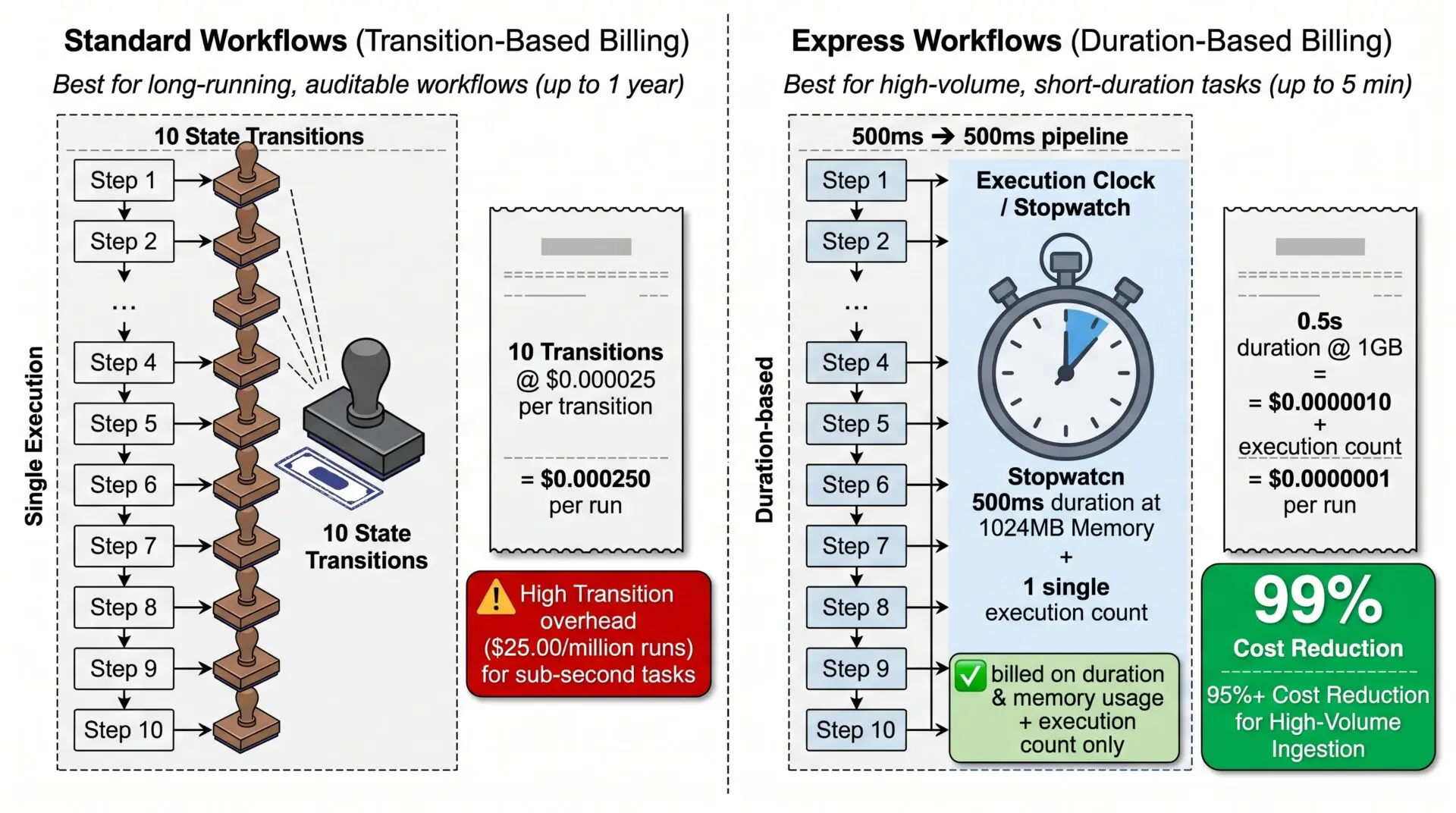
Step Functions Standard Workflows charge 0.025per1,000statetransitions(25.00 per million). If an event-driven ingestion pipeline processes 10 million transactions a month, and each execution passes through an 8-step state machine (evaluating payloads, invoking lambdas, writing to DynamoDB), that pipeline generates 80 million state transitions:
- 80 Million Transitions × $25.00 / Million = $2,000/month — just for workflow coordination, before paying a single cent for compute or database writes.
- Standard Workflows are engineered for long-running, auditable business processes (such as order fulfillment or human-in-the-loop approvals) that can run for up to a year.
- Using them for high-volume, sub-second streaming or webhook ingestion is an expensive architectural mismatch.
The Fix: Adopt Step Functions Express Workflows
For high-volume event processing, IoT data pipelines, and streaming ingestion running under 5 minutes, configure your state machines as Express Workflows. Express Workflows bill on execution count ($1.00 per million) and execution duration (down to 100ms increments), making them orders of magnitude cheaper at scale.
resource "aws_sfn_state_machine" "event_ingestion_pipeline" {
  name     = "high-throughput-event-processor"
  role_arn = aws_iam_role.step_functions_exec.arn

  # FinOps Fix: Switch from STANDARD ($25/M transitions) to EXPRESS ($1/M runs + duration)
  type     = "EXPRESS"

  definition = jsonencode({
    Comment = "High-throughput, cost-optimized event ingestion"
    StartAt = "ValidatePayload"
    States = {
      ValidatePayload = {
        Type = "Pass"
        Next = "ProcessRecord"
      }
      ProcessRecord = {
        Type     = "Task"
        Resource = aws_lambda_function.worker.arn
        End      = true
      }
    }
  })

  logging_configuration {
    level                  = "ERROR"
    log_destination        = "${aws_cloudwatch_log_group.sfn_logs.arn}:*"
    include_execution_data = false
  }
}
One trade-off to design around: the price difference reflects different guarantees, not just a discount. Standard Workflows give you exactly-once execution and a full, queryable execution history the service retains for up to 90 days.
Express Workflows trade that for scale. They run at-least-once (your steps must be idempotent, since a transient retry can replay a state) and keep no built-in, queryable execution history the way Standard does (Standard retains that history for up to 90 days).
With Express, your execution record lives in CloudWatch Logs instead, if you enable logging.. That’s why the configuration above defines a logging_configuration block: with Express, CloudWatch Logs is your audit trail, so log at least ERROR to retain visibility into failures without paying to emit every successful execution’s data.
Reserve Express for high-volume, idempotent, sub-5-minute work; keep Standard for workflows where you need exactly-once semantics or a durable, auditable record (order fulfillment, human-in-the-loop approvals).
The Legacy REST API Surcharge (API Gateway REST vs. HTTP API)
Amazon API Gateway provides two primary options for building serverless endpoints: REST APIs (v1) and HTTP APIs (v2).
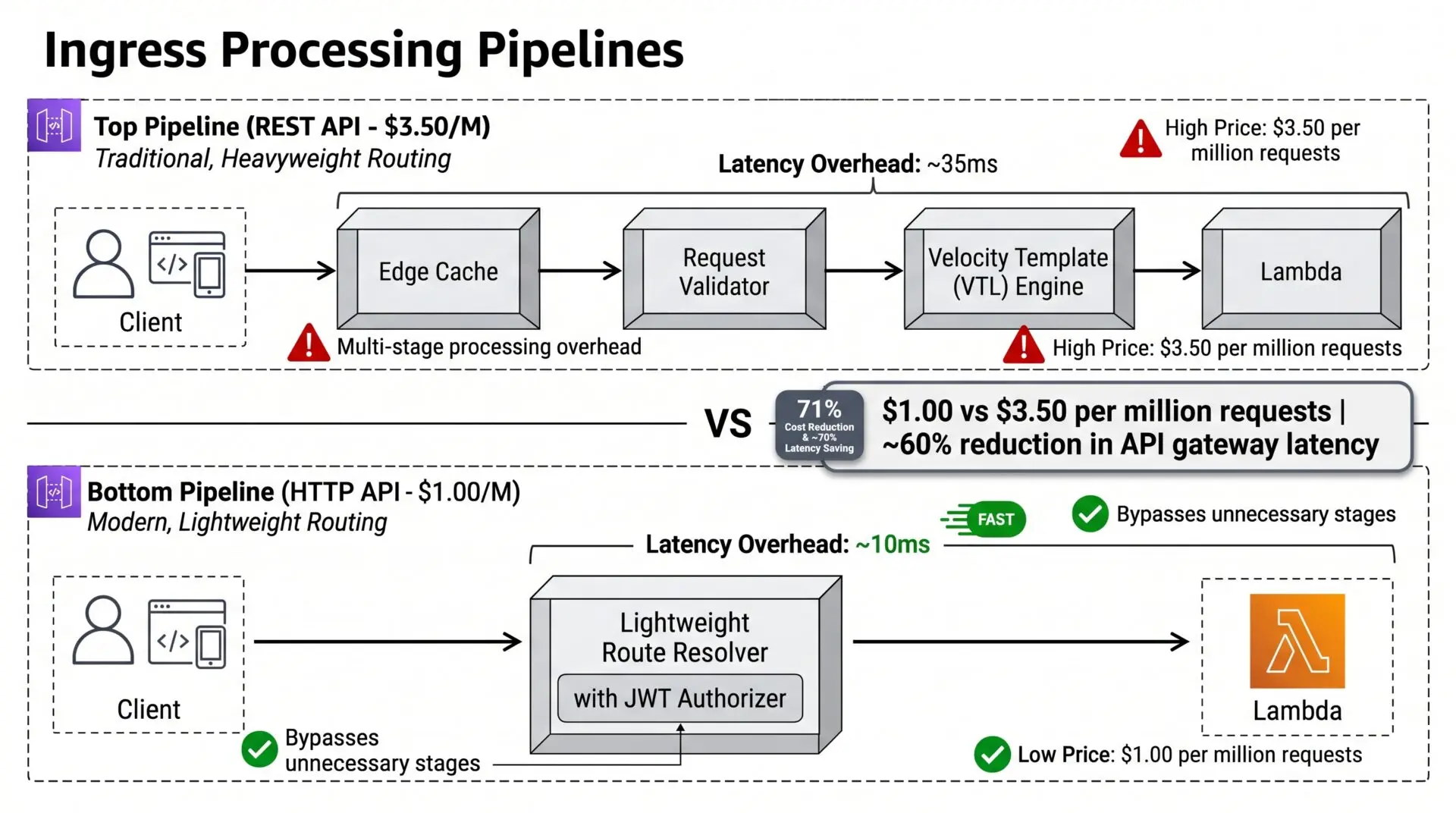
Many engineering teams continue to default to REST APIs simply because they represent the original API Gateway service. REST APIs cost $3.50 per million requests (for the first 333 million requests).
While REST APIs provide complex enterprise features like client-side SSL certificates, WAF integration, API key usage plans, and request validation, the vast majority of serverless endpoints operate purely as simple HTTP proxies passing JSON payloads directly to an AWS Lambda function.
The 71% Price Gap: HTTP APIs cost only $1.00 per million requests (for the first 300 million). Migrating straightforward Lambda proxy endpoints to HTTP APIs delivers an immediate, effortless 71% cost reduction on your ingress routing bill while reducing latency.
The Fix: Standardize on API Gateway HTTP APIs (v2)
Unless your workloads strictly require edge-optimized caching or native API keys, standardize your ingress endpoints on HTTP APIs.
resource "aws_apigatewayv2_api" "microservice_gateway" {
  name          = "serverless-checkout-api"
  # FinOps Fix: Slashes API Gateway ingress request fees from $3.50/M to $1.00/M
  protocol_type = "HTTP"

  cors_configuration {
    allow_origins = ["https://app.example.com"]
    allow_methods = ["GET", "POST", "OPTIONS"]
    allow_headers = ["Content-Type", "Authorization"]
    max_age       = 300
  }
}
The Empty-Receive Toll (SQS Short Polling)
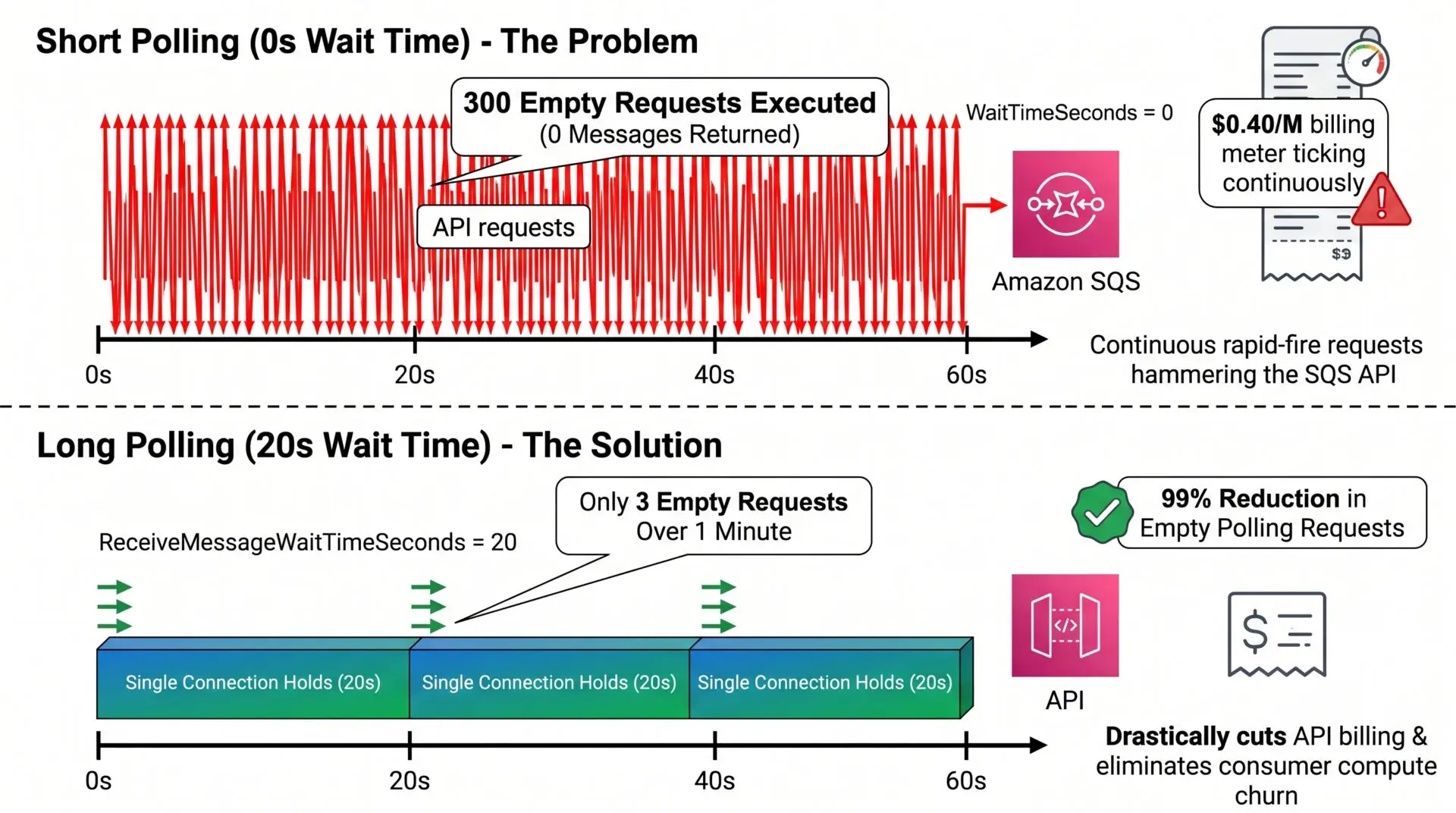
Amazon Simple Queue Service (SQS) charges $0.40 per million API requests (after the initial 1 million free requests each month). Every call to ReceiveMessage counts as an API request, regardless of whether any messages are returned.
By default, the ReceiveMessageWaitTimeSeconds attribute on an SQS queue is set to 0 (Short Polling). In short polling, AWS queries a subset of its distributed storage servers and returns immediately, even if the queue is completely empty.
If you run a distributed worker fleet (e.g., 20 container tasks or EC2 workers) continuously polling an empty queue, the request count climbs fast.
Take a worst case where each worker short-polls 5 times per second with no wait between calls: that is 100 requests per second across the fleet, or roughly 260 million empty ReceiveMessage calls a month (100 × 86,400 × 30 ≈ 259M). At $0.40 per million, that is over $100/month in pure waste, before counting the CPU and network the idle polling burns on every worker.
The Fix: Enforce Long Polling on Every Queue
Set ReceiveMessageWaitTimeSeconds to 20 seconds (the maximum allowed). With Long Polling, the call waits up to 20 seconds for a message to arrive before returning empty.
This simple configuration change slashes empty receive API calls by up to 99%, reduces worker CPU utilization, and reduces message delivery latency by returning items the moment they enter the queue.
resource "aws_sqs_queue" "order_queue" {
  name                       = "production-order-processing-queue"
  visibility_timeout_seconds = 300
  message_retention_seconds  = 86400

  # FinOps Fix: Maximum long-polling window eliminates empty-receive billing waste
  receive_wait_time_seconds  = 20
}
The 1-to-1 Invocation Penalty (SQS-to-Lambda Batch Window Neglect)
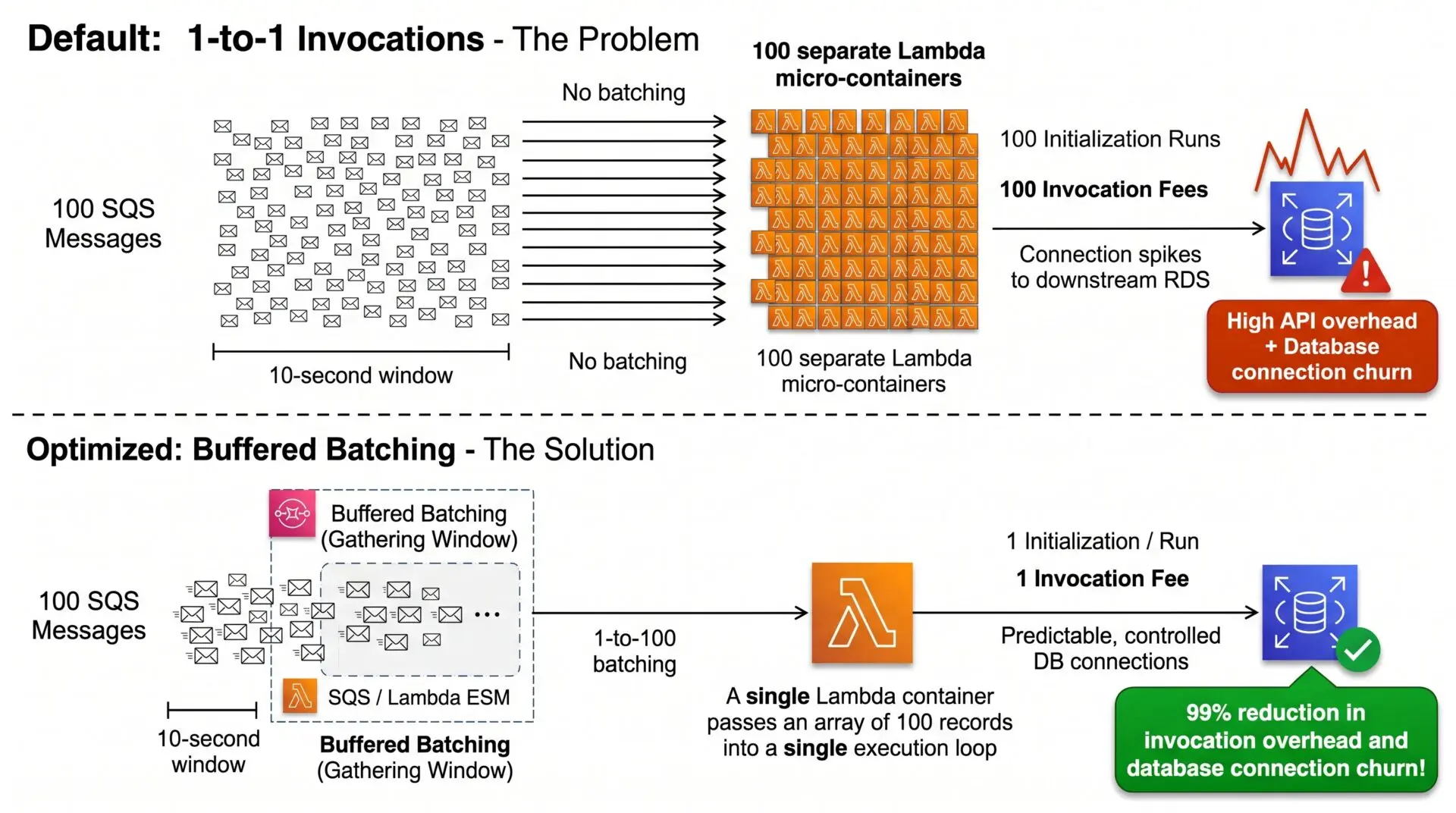
When engineering teams connect an Amazon SQS queue to an AWS Lambda function, they configure an Event Source Mapping (ESM). By default, AWS sets batch_size to 10 and maximum_batching_window_in_seconds to 0.
Because the batching window defaults to zero seconds, Lambda’s internal pollers do not wait to buffer incoming records. The poller invokes a Lambda function as soon as a single message becomes visible in the queue. If an upstream ingestion pipeline receives 50 million messages over a month in a continuous trickle, Lambda triggers up to 50 million separate invocations.
Each invocation incurs fixed initialization overhead, cold-start latency risk, a separate invocation request fee ($0.20 per million), and minimum billed duration. Worse, 50 million micro-invocations hammer downstream resources (such as Amazon RDS or Aurora databases) with thousands of concurrent connection spikes, often forcing teams to over-provision database compute just to survive connection exhaustion.
The Fix: Aggregated Batch Windows & Partial Failure Reporting
Configure your aws_lambda_event_source_mapping with an explicit batching window: set maximum_batching_window_in_seconds = 20 (or higher) and increase batch_size to 100.
Lambda buffers messages until the batch size is reached or the time window expires, collapsing thousands of micro-invocations into high-density executions.
To prevent an entire batch of 100 messages from failing if only one record contains malformed data, always pair large batches with function_response_types = [«ReportBatchItemFailures»].
This instructs your Lambda function to return only the specific failed message IDs (itemIdentifier), allowing AWS to re-queue only the failed items while completing the rest. Preventing expensive, repeated batch processing loops.
One caveat on the concurrency guardrail: maximum_concurrency is a protection for fragile downstreams, not a cost lever, and it cuts both ways. Set it to match what your database or API can actually absorb — too low and Lambda throttles the queue, messages retry, and the backpressure lands on your dead-letter queue instead of your wallet.
resource "aws_lambda_event_source_mapping" "sqs_batch_processor" {
  event_source_arn = aws_sqs_queue.order_queue.arn
  function_name    = aws_lambda_function.worker.arn

  # FinOps Fix: Buffer messages to collapse micro-invocations into high-density runs
  batch_size                         = 100
  maximum_batching_window_in_seconds = 20

  # Architecture Fix: Reprocess only individual failed records, avoiding full batch retries
  function_response_types = ["ReportBatchItemFailures"]

  # Concurrency Guardrail: caps concurrent invokes to protect a fragile downstream
  # (e.g. an RDS/Aurora connection pool). Valid range is 2-1000; an SQS event source
  # can otherwise scale to 1,250 concurrent invokes. Size this to your downstream
  # capacity: set it too low and Lambda throttles, messages retry, and pressure
  # shifts to your dead-letter queue. 50 here assumes a deliberately small DB pool.
  scaling_config {
    maximum_concurrency = 50
  }
}
Conclusion
Serverless architectures deliver tremendous operational agility, but cost governance extends far beyond tuning Lambda function memory.
By matching high-throughput workflows to Step Functions Express, modernizing legacy REST APIs to HTTP APIs, enforcing long polling across your SQS queues, and batching SQS-to-Lambda invocations, you stop paying for idle coordination and eliminate the hidden taxes running between your microservices.
Stop paying for coordination overhead. Build serverless architectures that only pay for real business transactions.
Scale with Automat-it FinOps
Speak with Tamir and the Automat-it FinOps team to benefit from cost optimization built on years of AWS expertise and experience working with similar companies.