

About Facewatch
Facewatch is the UK’s leading facial recognition company providing a cloud-based facial recognition security system to safeguard businesses against crime and create a safer environment for customers and colleagues.
Facewatch is simple, secure, UK law-compliant, and proven to stop crime before it happens. The system matches faces against known offenders as they enter your premises and sends an alert instantly, and a database is shared by geography with every Facewatch subscriber, helping to deter thieves operating in your area.
The Challenge
The new Facewatch infrastructure needed backups to be stored in a separate AWS account for disaster recovery and compliance purposes.
The Solution
The Facewatch solution utilizes several Amazon RDS instances for persistent storage, Amazon EC2 instances to deploy applications and a web portal, and Amazon S3 buckets for data for facial recognition.
AWS Backup Audit Manager was used to gain visibility of backup activity, evaluate the compliance of backups with business and regulatory policies, and generate audit reports.
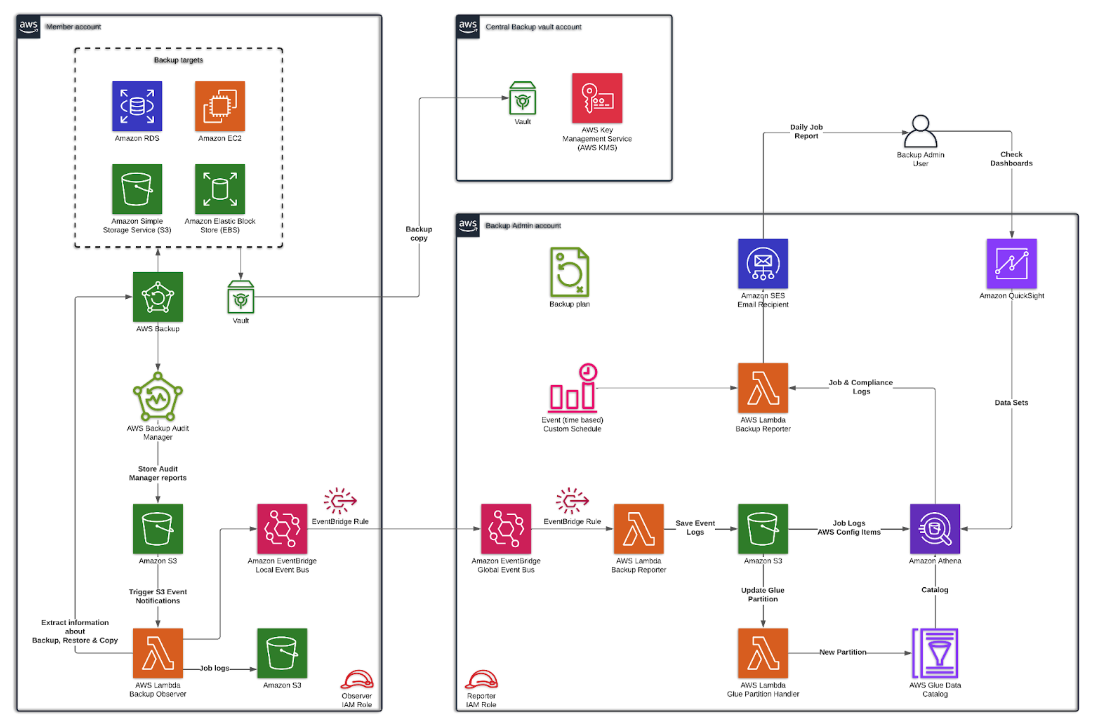
Now, Facewatch can use the backup observer tool deployed by Automat-it for AWS Backup to automatically obtain daily, aggregated, cross-account multi-region reports.
The backup observer solution for AWS Backup is a deployable, event-driven solution built on serverless architecture. It complements and integrates with AWS Backup and AWS Backup Audit Manager features to provide customers with enriched daily data protection reporting.
See the below image to see it in more detail.

The backup observer solution enables customers to:
- Automatically generate, store, and email out daily reports: The deployed solution provides a set of aggregated daily job reports that are cross-account and multi-region based. These reports are stored in a central S3 bucket, enabling customers to access historical backup reports as required.
Example:

- Visualize and gain insights into data protection through dashboards: Automat-it deployed the backup observer Amazon QuickSight dashboards, which leverage data generated by the solution. These dashboards enable Facewatch to obtain rich visualization encompassing backup details and trends for their AWS Backup environment.

FaceWatch can also save time and effort by using the backup observer solution to obtain simplified observability of data protection activities, which can span across AWS accounts and regions.
Automat-it’s 24/7 NOC team also provides incident management services. The security, NOC, and DevOps teams continuously monitor the infrastructure, applications, and compliance.
The Results
- A scalable, highly available, secured, stable, and monitored multi-account environment with cost-effective centralized backup management.
- Data backups are regularly created and copied to a separate AWS account, thereby improving security and reducing risks.
- Using AWS Backup Audit Manager to automate detection of drifts in AWS Backup data protection policies, and provide organization-wide cross-account, cross-region reporting.
- AWS Backup Audit Manager has been deployed at scale and consumes the Facewatch organization’s compliance findings in Amazon Quicksight.
- Facewatch now benefits from monitoring its organization’s compliance data via interactive dashboards, enhancing visibility and enabling more informed decisions about its AWS Backup environment.
- 24/7 monitoring of alarms and a secured centralized log archive.
Get started
Want the same level of control and confidence over your backups and storage? Contact Automat-it to streamline backup management, reduce storage complexity, and build a more resilient, cost-efficient cloud environment.